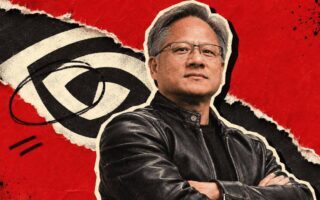
Late at night on November 12th, Beijing time, Silicon Valley released a thunder that was enough to shake the global technology industry.
Nvidia’s official website issued a statement that the company’s board of directors has approved Huang Renxun’s resignation as the company’s president, CEO and director, effective immediately. Colette Kress, the company’s current executive vice president and chief financial officer, will serve as interim CEO and will continue to serve as CFO until a formal successor is determined. The board of directors will initiate a selection process for a new CEO and will consider both internal and external candidates.

It has only been four days since Huang Renxun publicly admitted his extramarital affair. The 33-year leadership career came to an abrupt end in such an unexpected way.
This AI empire with a market value of trillions has been pushed into deep waters without a helmsman.

1. The AI era defined by one person
In the spring of 1993, when 30-year-old Jen-Hsun Huang and two colleagues founded Nvidia in Santa Clara, California, no one thought that this small company that made graphics chips would in the future revolutionize the computing power of mankind.
In the first few years of its business, Nvidia was on the verge of bankruptcy several times.
At the worst time, the company laid off 70% of its employees. Huang Renxun later repeatedly said, “We are always only 30 days away from bankruptcy.” It was the realization of survival with real swords and guns.
What saved the company in the end was Sega’s $5 million in licensing-related payments. Huang Renxun flew to Tokyo and confessed face to face that the technical route had failed and the project could no longer perform. Sega recognized his honesty, and even if the project was terminated, it still paid the money, leaving Nvidia room to turn around and continue its life.
With this money, the team went all-in on the Direct3D standard graphics card route and launched the RIVA 128 in 1997. Shipments soon exceeded one million, and NVIDIA truly gained a foothold.
1999 was the first milestone. Nvidia landed on Nasdaq and released GeForce 256 in the same year. It proposed the concept of GPU for the first time and separated the core graphics rendering work from the CPU. A new hardware category was born.
But what really decided Nvidia’s fate was the gamble in 2006 that withstood the doubts of all Wall Street – the launch of the CUDA general computing architecture.
In the eyes of everyone at the time, GPUs were just for playing games, and spending a lot of money on general computing was completely unprofessional. Huang Renxun defied public opinion and spent huge sums of research and development expenses every year to polish the CUDA ecosystem. This was an idle move that came to the fore six years later.
In 2012, Hinton’s team used two Nvidia graphics cards to train AlexNet and won the ImageNet competition championship. For the first time, the world discovered that GPU trains neural networks dozens of times faster than CPU.
Huang Renxun did not hesitate and immediately pledged the fate of the entire company to AI.
In 2014, it launched the cuDNN neural network acceleration library; in 2016, it took out the DGX-1AI supercomputer and personally delivered the first machine to the then OpenAI headquarters.
We have all seen the story behind it.
ChatGPT exploded in popularity at the end of 2022, and the generative AI wave swept the world. Nvidia’s GPUs turned into digital oil overnight, and orders were scheduled for several years. The stock price also rocketed, with the market value exceeding US$5 trillion, surpassing Apple to become the world’s number one.
In the past three years, Huang Renxun has been the overall anchor of the global AI industry. Every speech, every new chip, and every judgment he makes affects the capital expenditures, technical routes and even the life and death of global technology companies.
It is rare in business history for a company to define an era, and Jen-Hsun Huang did it.
2. The scandal that broke the scepter
No one expected that the cracks in this trillion-dollar building would start from the most personal place.
When Huang Jen-Hsun issued an internal letter admitting his extramarital affair four days ago, many people thought that the storm would soon pass. After all, in Silicon Valley, it’s nothing new for founders with a net worth of hundreds of billions to have emotional turmoil.
But the fermentation speed of the situation far exceeded everyone’s expectations.
Huang Renxun’s love affair involves more than one woman. Subsequently, the New York Times quoted people familiar with the matter and revealed that the other woman involved was Kimberly Powell, vice president of Nvidia’s medical and health business who reported directly to him.
This directly touches the red line of corporate governance in Silicon Valley.
A manager’s close relationship with a direct report, whether consensual or not, constitutes a clear conflict of interest. Eight years ago, Intel CEO Krzanich was directly dismissed by the board of directors for the same reason, even though the relationship had long since ended.
Even more deadly is another layer of shadow – the suspicion of overseas intelligence infiltration.
NVIDIA’s board of directors has already launched an independent investigation, hiring a former federal prosecutor to take the lead. The scope of the investigation is not only related to relevant personal relationship disputes, but the core focus is also to verify whether there are national security and trade secret risks.
For a company that controls the world’s most core computing infrastructure, this is the real life and death line.
In the final analysis, the board of directors’ decision is not a moral judgment, but a calculation of interests. The higher Huang Renxun’s personal prestige and the more concentrated his power, the more fatal the shock to the company, shareholders, and the entire industry chain will be if risks arise.
Huang Renxun won all the technology wars, but ultimately lost to the iron law of corporate governance.
3. it’s all over
When I say “everything is over”, I don’t mean that NVIDIA will go bankrupt. Its technical barriers are still there, orders are still there, and the CUDA ecological moat is still bottomless.
What really ends are three eras.
The first to end is Huang Renxun’s personal legendary era.
In the past, NVIDIA did not have a COO for a long time. About 60 senior executives reported directly to the CEO. Almost all major decisions of the company were made by Huang Renxun.
This extremely flat architecture allows Nvidia to run the fastest in the AI wave, but it also leaves the most vulnerable single point of risk.
From now on, Nvidia may officially move towards the stage of professional manager governance. It will be more robust and compliant, but it will most likely lose that all-or-nothing risk-taking spirit.
The second end is the market’s belief in Nvidia’s valuation.
In the past, the capital market was willing to give Nvidia a high valuation, not only buying its current performance, but also Huang Renxun’s ability to predict the next technology wave.
Now that the helmsman has left the market, the valuation logic must be restructured.
The 10% drop before the market opened was just the market’s first reaction. In the next few quarters, people will re-examine whether Nvidia can continue to define the next generation of computing power without Huang Renxun.
The third end is the unipolar order of the AI industry.
In the past few years, Huang Renxun has relied on his personal prestige to control TSMC’s production capacity upstream and the procurement rhythm of cloud manufacturers downstream. The entire AI computing power industry chain revolves around Nvidia’s rhythm.
Now, the leadership has entered a transition period, giving competitors a window to breathe.
AMD will accelerate its efforts to seize the high-end computing power market. Cloud vendors such as Microsoft and Google will increase their investment in self-developed chips. Even the construction of sovereign computing power in various countries around the world will re-evaluate the risk exposure of the supply chain.
The golden age of AI computing power dominated by one company may be about to change with the departure of Huang Renxun.
4. 結語
Jen-Hsun Huang’s departure reminds me of countless familiar scenes in business history.
From Intel’s Grove to Microsoft’s Gates, from Apple’s Steve Jobs to Amazon’s Bezos, every great technology company must eventually go through the era of founders and move towards organizational inheritance. It’s just that very few people leave in such an unseemly way.
Jensen Huang is certainly one of the greatest business leaders of our time. But the cruelty of the business world is that you create the era, and you must ultimately obey the rules of the era.
A legend has come to an end, but the wave of AI will not stop.
Just like Intel was still running without Grove, Apple was still the world’s most valuable company without Steve Jobs, and NVIDIA without Jen-Hsun Huang would still be the most important player in the computing industry.
It’s just that the first half of the AI, which was dominated by a man in a leather jacket, rushed forward, and had a strong color of personal heroism, is really over.
Related Reading
- Depth丨The outcast Huang Renxun, and the trillion-dollar Nvidia that has lost its helmsman2026-11-15
- Original: Wang Jianlin, 72, re-appointed as chairman of Wanda2026-11-15
- The former chairman voluntarily surrendered! With three changes of leadership in four years, how many question marks does Xiamen Bank hide?2026-11-15
- Behind the U.S. grounding: the air traffic control system has been in service for 50 years, and spare parts rely on overseas purchases2026-11-15
- Hesai, Shenghong, and Nvidia reveal the “pricing system” of technology tycoons’ extramarital affairs2026-11-14