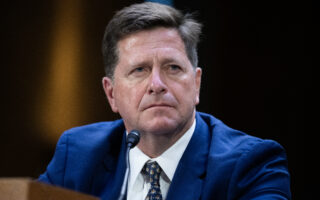
President Trump on Sunday named Director of National Intelligence Jay Clayton as his new “AI czar,” adding a different category of intelligence, the “artificial” kind, to the U.S. spy chief’s portfolio.
In a post on Truth Social, Trump said Clayton will lead a newly formed “Super Intelligence Force” alongside Federal Trade Commission Chair Andrew Ferguson, Under Secretary of Defense for Research and Engineering Emil Michael and Office of Personnel Management Director Scott Kupor. The group will report directly to Trump and White House chief of staff Susie Wiles.
Its goal, Trump wrote, is “to ensure that America continues to lead the World in Super Intelligence, which many say is bigger than the Industrial Revolution, and the Internet, and will protect the interests, and improve the lives, of all Americans.”
Clayton will keep his job as DNI, which oversees the nation’s 18 intelligence agencies.
Trump’s announcement follows meeting last Tuesday at the White House where top AI executives signed what he called a “morally binding” agreement to police themselves in order to prevent their increasingly powerful models from going rogue and harming humanity.
“There’s a belief that there should be tremendous self-regulation,” the president said at the meeting. “This is going to be all for the good, and we’re going to have it be nice and safe.”
Despite new polls showing that 86% of Americans want AI companies to meet independent safety standards even if doing so slows development — with 74% largely mistrusting the leaders of those companies — Trump insisted in recent days that federal regulations are unnecessary and that those who say otherwise are “Conspiracy Theorists, Treasonists, Traitors, and Leakers.”
“The only control or ‘guardrails’ that AI needs is a STRONG AND SMART (High IQ!) PRESIDENT, and the U.S.A. has that, in spades!” he wrote on social media. Elsewhere, Trump has said that regulation would handicap the U.S. in its race to “win” AI.
“Whoever wins AI … that’s the group that wins,” Trump told the United Nations General Assembly last month. “We’re leading now over China by a lot and everyone else, and we’re going to keep it that way.”
According to the Guardian, Trump’s previous AI and crypto czar, billionaire tech investor David Sacks, consistently “counseled the president to give a soft touch to AI regulation, helping push executive orders and other measures aimed at loosening restrictions on the technology.” Sacks also “maintains direct financial stakes in multiple AI companies,” the paper reported, though he took steps to divest some of his holdings last year while serving in the administration. He stepped down in March.
Will Clayton follow Sacks’s lead? Or will he chart a new course? Here’s what we know so far.
Who is Jay Clayton?
Clayton, 60, is a registered independent with degrees from the University of Pennsylvania (engineering, law) and the University of Cambridge (economics). As a lawyer in private practice, he focused mostly on Wall Street: mergers and acquisitions, market offerings and regulatory proceedings. During Trump’s first term, from 2017 to 2020, Clayton chaired the U.S. Securities and Exchange Commission. From March 2021 to April 2025, Clayton served as chair and “lead independent director” of the board of Apollo Global Management. (Apollo has owned a 90% majority stake in Yahoo since September 2021.)
In late 2024, Trump nominated Clayton to serve as U.S. Attorney for the Southern District of New York, his first prosecutorial job; Trump later appointed Clayton to serve in an acting capacity after New York Sen. Chuck Schumer blocked his appointment. Reports suggest Clayton was also considered for roles as secretary of the treasury, attorney general and director of the Central Intelligence Agency. In November 2025, Trump ordered the Department of Justice to investigate Democrats associated with Jeffrey Epstein, and U.S. Attorney General Pam Bondi assigned Clayton to lead the probe.
After former Director of National Intelligence Tulsi Gabbard resigned in May 2026, Trump tapped Clayton to replace her. “He’s very qualified,” Democratic Sen. Mark Warner of Virginia said at the time. But Clayton sidestepped questions over who won the 2020 election during his July confirmation hearings, and he was confirmed without Democratic support.
“I’m not an election denier,” Clayton told the Senate. “He went through our processes, and Joe Biden became the president of the United States.”
What has Clayton said about AI?
During his DNI confirmation hearings, Clayton described AI as “a game changer,” warning that it represents “not only an opportunity but a threat.”
“We should just all recognize that,” he continued. “When something is both an opportunity and a threat, you better get your arms around it.”
On Tuesday, Clayton attended Trump’s White House meeting with top AI executives. Speaking afterward to CNBC, he used the president’s new preferred term for AI — i.e., “superintelligence” — while pushing back against lawmakers who have called for regulating or pausing U.S. AI development.
“Super intelligence is a national security issue, and that was something that was recognized yesterday by not just the industry leaders but everybody in the room,” Clayton said. “But to, in some way, not try to drive forward inside the United States, with companies that are regulated in the United States … to somehow say we should back away from this and let the rest of the world develop these models and implement these models? I don’t think anybody in that room, and I don’t think any American, should think that that’s a good strategy.”
Asked to respond to criticism from Democratic Sen. Elizabeth Warren of Massachusetts that Trump’s current policy of letting AI companies police themselves will prove to be “a recipe for disaster,” Clayton suggested that the U.S. government’s existing regulatory framework could also help keep AI in check.
“My response to the American people on that front is we have a Federal Trade Commission, we have a Department of Justice,” Clayton said. “I know the leaders of both those organizations, and they’re committed to protecting the American people in this regard.”
What will Clayton do as AI czar?
According to Trump’s post, the Super Intelligence Force will coordinate the federal government’s dealings with AI companies, infrastructure providers, consumers, public interest groups and religious organizations, CNN reported.
Last month, Trump wrote on social media that he would “be announcing, in the near future, the AI ‘Czar.’
“Only High I.Q. individuals need apply!” he added.
In the same post, the president again dismissed concerns about AI safety as a “hoax” perpetrated by “Radical Left Democrats.” He also wrote that going forward, his administration would not “in any way hinder or stifle the Growth of this incredible Industry,” which he described as “the next Industrial Revolution, or Internet” — only “even larger and more impactful.”
“Rather, we will cherish it, help it, and watch over it, as it grows!” Trump explained. As for reining in “bad” actors, he wrote, “we can do that, very easily, with our already existing Criminal and Civil Justice System.”
Clayton, it seems, will now be in charge of cherishing, helping and watching over the AI industry as it grows. He’s “a good man,” Trump told Axios when the outlet asked last week if Clayton was being considered for the job. “He’s right here. That’s a good idea.”
It’s unclear what happened to a separate idea Trump floated last month, which he called “the AI Force.”
“I am forming the AI Force, much like I did Space Force, which has been a tremendous SUCCESS, in my First Term,” Trump wrote in his September social media post about naming an AI czar.
According to Axios, Trump’s AI Force idea “caught advisers by surprise,” setting off “a mad dash” within the administration “to imagine what AI Force would look like.”
What did Trump’s previous AI czar do?
When Sacks served as AI czar, he repeatedly persuaded the president and his administration to resist new AI restrictions, including state laws to limit AI. Since leaving the White House, Sacks has “maintained close ties with the president,” according to the Guardian, and “in May, he successfully urged Trump to scrap an executive order that would’ve subjected AI models to government review.”
The Wall Street Journal recently reported the Treasury Secretary Scott Bessent and White House chief of staff Susie Wiles were “caught off guard and unhappy” with Trump’s decision after they “spent months negotiating to increase oversight of AI and had consulted a range of industry executives on the order.” According to the Journal’s sources, Wiles “told others that Sacks had persuaded Trump” to back down “in a last-minute call,” leaving Bessent “worried that AI-led cyberattacks could wreak havoc on the nation’s banking system.”
Related Reading
- Russian drone slams into Kyiv bridge in escalating campaign as Germany’s chancellor arrives to airsirens and explosions2026-10-05
- Cornell rape case: How the university reportedly punished each of the 7 men accused, from expulsion to ‘reflection papers’2026-10-05
- Trump names Jay Clayton as AI czar. Who is America’s new artificial intelligence chief — and how will he address growing safety concerns?2026-10-05
- dead and 35 injured in mass shooting at Georgia homecoming celebration2026-10-05
- Iran tells U.S. there is no military solution to Middle East war2026-10-04