In the past two days, new news has come out of DeepSeek: the company is about to welcome a CFO born in the 1990s – Yan Wentao. As soon as the news came out, the market naturally had some discussion. After all, Liang Wenfeng is only “one step away” from being the richest man in China. Now he has another “go-getter” who understands both industry and capital. This has given the outside world more imagination about the future development of him and DeepSeek.
Article | Financial Gossip Female Contributing Author: Fang Fang in Armor
· · ·
Liang Wenfeng is one step closer to becoming the “richest man in China”.
In the past two days, new news has come out of DeepSeek: the company is about to welcome a CFO born in the 1990s – Yan Wentao.
Despite his young age, this “capital veteran” has quite a resume. It has previously invested in many star projects such as Byte, Xiaohongshu, and MiniMax, and its investment vision has attracted much attention.
As soon as the news came out, the market naturally had some discussion.
After all, Liang Wenfeng is only “one step away” from being the richest man in China. Now he has another “go-getter” who understands both industry and capital. This has given the outside world more imagination about the future development of him and DeepSeek.
On one side, there are post-90s investors who are good at catching technology trends; on the other side, there are young entrepreneurs who are rapidly rising with AI technology. The meeting between the two “happened” to happen at the critical node of DeepSeek’s move towards IPO. It’s no wonder that the capital circle became lively again.
1./ From quantification to large models, Liang Wenfeng did not make a sudden turn/
Liang Wenfeng is not an entrepreneur with a halo.
Liang Wenfeng, who came from an ordinary family when he was a child, was known for being good at mathematics. When he was studying in Wuchuan No. 1 Middle School in Guangdong, he was the top student in the school. In junior high school, he had already completed high school mathematics ahead of schedule and even started to learn college mathematics. However, he is not the “student machine” that everyone imagines that only immerses himself in studying. He should usually have fun and relax, but his learning efficiency is particularly high.
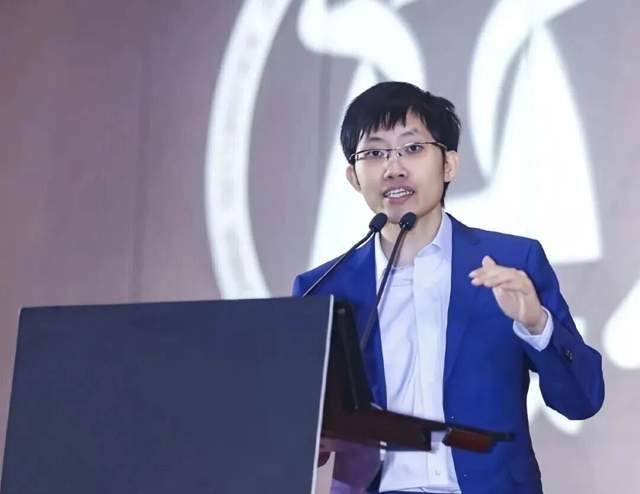
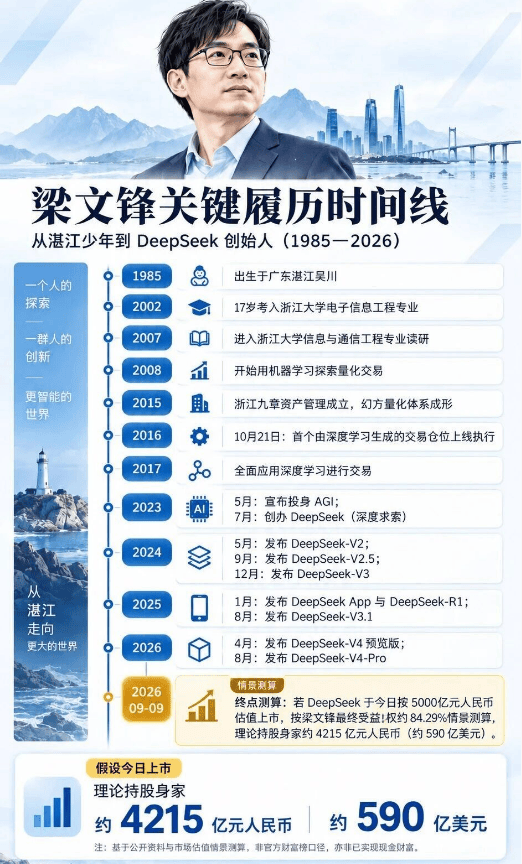
In 2002, 17-year-old Liang Wenfeng won the first place in the science college entrance examination at Wuchuan No. 1 Middle School and entered the electronic information engineering major of Zhejiang University. At that time, his class teacher suggested that he apply for Tsinghua University, but Liang Wenfeng finally chose the direction he was interested in.
This choice is actually very similar to his later style of doing things:
Others focus on which path is more popular, but he cares more about what he really wants to study.
While at Zhejiang University, Liang Wenfeng continued to cultivate technology. In 2007, he was admitted to Zhejiang University as a graduate student majoring in information and communication engineering, with his research direction being machine vision. If you follow the normal route, it is also a good trajectory to enter a large factory and do technology research and development after graduating with a master’s degree.
Liang Wenfeng didn’t go like this.
In 2008, while still in graduate school, he, his senior Xu Jin and others began to study quantitative trading, hoping to use machine learning and algorithms to let computers help complete investment decisions. In those years, quantitative investment was not as popular as it is today. Many investors believed more in experience, judgment and market feeling. Letting computers participate in investment was even a bit “fantasy” in the eyes of many people.
But Liang Wenfeng is willing to try.
After graduating with a master’s degree, he went to Chengdu and continued to study quantitative models in a rental house. With the launch of stock index futures, quantitative investment has ushered in development opportunities. Liang Wenfeng’s team continued to optimize their strategies by leveraging their algorithm advantages, and their own funds grew from the initial tens of thousands to hundreds of millions, and they also completed the accumulation of their first pot of gold in their lives.
However, just making the first pot of gold is not his end.
The experience of doing quantification made Liang Wenfeng realize a problem very early:
In the future, the competition will not only be data, but also computing power.
Quantification itself is an industry that relies heavily on algorithms, data and computing power. The more complex the model, the more information needs to be processed and the higher the requirements on computing resources.
Therefore, when Magic Square invested large-scale computing power later, it was not a sudden move to “play AI”, but a continuation of his thinking over the past ten years.
In 2019, Magic Square invested nearly 200 million yuan in building “Yinghuo 1” and deployed 1,100 GPUs; in 2021, it invested nearly 1 billion yuan in building “Yinghuo 2” and used about 10,000 A100 GPUs.
At that time, many people did not understand:
Why does an investment company spend so much money on chips?
But in Liang Wenfeng’s view, computing power is not a simple hardware investment, but a part of research capabilities.
It is precisely because of these accumulations that when the wave of large models arrives in 2023, Liang Wenfeng’s switch to AI will not be so sudden.
That year, ChatGPT exploded in popularity around the world, and various companies joined in the competition for large models. Some people were busy raising funds, expanding teams, and grabbing GPUs, while DeepSeek’s pace was relatively low-key.
Liang Wenfeng did not rush to expand the company, but focused more on model development and technology optimization.
In 2025, DeepSeek-R1 attracted attention after its release. The outside world found that it did not simply follow the route of “large investment and large-scale computing power”, but made new explorations in algorithm efficiency and training methods.
Traditional large model training usually requires giving the model a large number of demonstrations first, so that it can learn the problem-solving process that humans have summarized. Liang Wenfeng changed his approach:
Instead of directly telling the model what to do at each step, and not providing problem-solving demonstrations to the model, it allows it to explore its own solution path.
If the result is right, reward it; if the result is wrong, continue to adjust. In the process of continuous trial and error, the model gradually learns to check its own answers and spends more time reasoning when it encounters complex problems.
To put it simply, we no longer rely entirely on manually teaching “problem-solving methods” to the model one by one, but let the model find its own way to solve the problem through training.
Another aspect of this model that deserves attention is the cost.
DeepSeek disclosed in the paper that the total cost of the post-training phase of the R1 series is only about US$294,000. This number is still topical in today’s AI industry.
In the past few years, the large model industry has been continuously increasing its computing power. Models are getting bigger and bigger, more and more GPUs are needed for training, and data centers are getting bigger and bigger. Many times, the competition in the industry is who can get more chips, more data and more funds.
Liang Wenfeng told everyone:
The scale of computing power is important, but how it is used is equally important.
From this perspective, there is some “inevitability” in his transition from quantification to AI.
However, in the past, he was faced with data and strategies in the financial market, but now he is faced with a larger and faster-changing AI industry. Next, what DeepSeek has to face is how to continue the proven technical route and push the model to more scenarios.
2./ Why does Liang Wenfeng, who is not short of money, still turn to financing /
Now, DeepSeek’s valuation has reached hundreds of billions of yuan, and Liang Wenfeng holds about 84.29% of the shares (the total of direct and indirect shareholdings). If the company’s market value reaches 1 trillion yuan in the future, based on this shareholding ratio, his book wealth will most likely surpass Zhang Yiming and become the richest man in China.
Of course, just look at the book value.
But the changes behind this number are worth noting. Liang Wenfeng moved from adhering to the “three no’s principles” (no financing, no commercialization, and no road shows) to capital.
In the early days, DeepSeek did not actually need capital markets. As of the end of 2025, Liang Wenfeng has achieved Huanfang’s average income of 114.35% in the past five years, and he has enough confidence to conduct research at his own pace. For a start-up technology company, this state is indeed more comfortable.
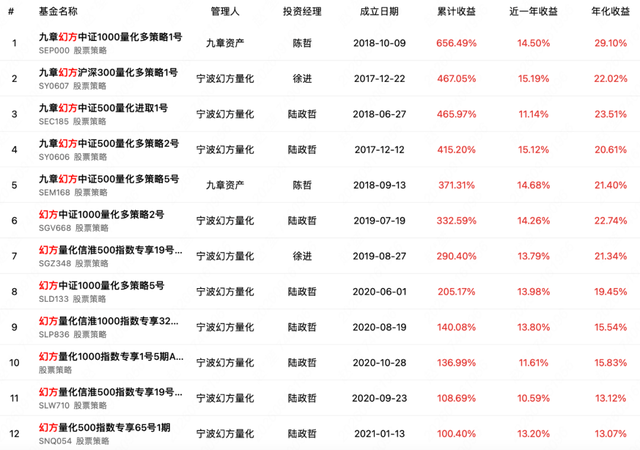
▲Yield rate of some Magic Square products/Source: Private Equity Ranking Network
However, the competition and development of AI models require continuous investment in computing power, talents and infrastructure. It is difficult to cover such a large investment with Liang Wenfeng’s personal funds alone. Financing came naturally.
In June 2026, DeepSeek completed its first external financing since its establishment, with a fundraising scale of approximately 51 billion yuan and a post-investment valuation of approximately 338 billion yuan. Liang Wenfeng himself promised to invest 20 billion yuan, and Tencent, CATL, and the “National Team” also participated. Since then, it has been reported in the market that DeepSeek plans to conduct a new round of financing with a valuation of approximately 500 billion yuan. However, this round of financing was later revealed to be postponed, and it cannot be considered official yet.
In September, foreign media reported that DeepSeek had hired CITIC Securities to prepare for the IPO of the Science and Technology Innovation Board and planned to start the application within the year.
Usually, the founder of the company is responsible for finding the direction, the investors provide funds, and both parties work together to make the company bigger. But Liang Wenfeng has another way of thinking: external funds can come in, but he will continue to invest himself. The company’s original technical route and R&D rhythm will not fundamentally change due to financing.
In other words, Liang Wenfeng needs capital, but it does not mean that the company’s development should be decided by capital.
However, the AI industry has an unavoidable problem, which is burning money.
In the first seven months of this year, Liang Wenfeng spent about 11 billion yuan on AI infrastructure, including renting AI chip servers and purchasing computing equipment. But for the whole of 2025, this number will only be about 1.2 billion yuan. In more than a year, expenses have skyrocketed nearly 10 times. As for R&D, it’s not like investing money today and seeing results tomorrow. For many projects, it may take several years to see results.
As the company grows bigger, how to spend the money has become an unavoidable problem for Liang Wenfeng. Should we continue to increase computing power or expand our team? Is it to supplement infrastructure or to leave room for future research and development? In the past, Liang Wenfeng was more accustomed to focusing on technology, R&D, and efficiency. But now, no matter how strong a person is, he cannot handle everything to the end.
Liang Wenfeng can still firmly control the technical direction and R&D pace; but financial management and capital planning, which are more capital-oriented matters, need to be handed over to more professional people.
In this context, a position that was not very prominent in the past began to become important – CFO.
3./ On the road to becoming the richest man, Liang Wenfeng still needs someone who understands capital/
If Yan Wentao joins DeepSeek, it means that the company is filling the “missing corners” in capital and management.
Yan Wentao, born in 1991, graduated from Fudan University. Previously, he worked at Tencent Investment and H Capital. In 2020, he joined Hillhouse Venture Capital and became a representative figure among the younger generation of investors in Hillhouse. In 2025, he was selected into the TOP50 Nova Rising Star Investors.
Foreign media once used the term “dealmaker” to describe him. Simply put, he is a person who is good at discovering opportunities and promoting transactions. He has publicly stated that the core of science and technology investment is to find the biggest technological proposition of the era and the people who can answer this question.
In fact, it is not too late for Yan Wentao to pay attention to the AI track. In 2020, he began to study the field of large models; in 2023, he turned his focus to embodied intelligence. In his view, the window period left for investors in each technology wave is very short. The key is to find companies and entrepreneurs who can seize the opportunity.
It is worth noting that both MiniMax and Zhipu AI, which he participated in the investment, have started the IPO process of the Science and Technology Innovation Board and signed mentoring agreements in May and February of this year respectively. This also means,Yan Wentao is no stranger to the entire process of large-scale AI model companies from early growth to sprinting into the capital market.
Of course, Hillhouse is not an investor in DeepSeek, so if Yan Wentao eventually joins DeepSeek, it will not be an “investor bet project” in the traditional sense. Looking more closely, what both parties value may be a common understanding of technology industry trends and capital market logic.
DeepSeek’s search for a CFO has actually been going on for some time.
As early as February 2025, the company publicly released CFO recruitment information. In June 2026, DeepSeek announced that the size of all departments would at least double. In the recruitment of the official website’s financial team, CFO is still one of the core positions.
However, DeepSeek obviously needs more than just a financial leader in the traditional sense.
According to the company’s official recruitment requirements, the CFO needs to be familiar with accounting standards and tax policies, hold CPA qualifications preferred, and be able to establish a complete compliance and risk control system. However, Yan Wentao’s advantage lies not in his professional background in finance, but in his long-term participation in technology investment and his deep understanding of AI industry development and capital market operations.
To a certain extent, he is more like helping DeepSeek complete a “translation”:
Transform technological advantages into business logic that the capital market can understand, and transform the potential of a technology-driven company into a clearer development path.
In the past year, with the rapid development of DeepSeek in the field of AI, Liang Wenfeng’s personal wealth has also increased, with his net worth increasing from approximately US$1 billion to US$39.9 billion, ranking 51st in the world.
▲Liang Wenfeng’s latest net worth as of September 16/Source: Forbes
However, the increase in wealth figures is only superficial. The key to how high Liang Wenfeng can reach in the future, and whether he can even hit the “richest man in China”, depends on whether DeepSeek can truly turn its technical advantages into commercial value.