
Deep Diving Studio submission email: hxxw2019@qq.com
Mr. Wu in Foshan did not expect that when he first approached a loan company to fill a financial gap, not only did he fail to solve his urgent need, but he fell into a trap twice. The business eventually went bankrupt, and many relatives were saddled with huge debts and their credit scores were damaged.
Mr. Wu’s experience is not an isolated case. Since this year, many victims have reported their experiences of being defrauded to “Red Star Deep Dive Studio”, pointing to some seemingly formal loan assistance companies on the market, but in fact they set up traps step by step and harvest a large number of customers. In order to uncover the shady operations of these companies, in June 2026, Red Star Deep Dive reporters went undercover as a job seeker to a loan assistance institution in Guangzhou.
The reporter’s undercover investigation found that the loan assistance company had more than 100,000 pieces of suspicious citizen information, pretended to be bank staff through telemarketing, and used a set of brainwashing techniques to deceive borrowers from all over the country. They have dedicated personnel who perform double roles as risk control executives and credit managers stationed by the bank. They are also involved in illegal operations such as AB loans and housing financing, and the service fee can be as high as 20%. The loan assistance company even claims to be “connected with bank insiders” and can “artificially control the lending time” to ensure receipt of service fees.
(一)
Falling into the loan trap twice
Many relatives are in huge debts
Mr. Wu only filled out a loan application online, and his personal information was transferred to the loan institution.

▲The reporter’s undercover loan assistance company is surrounded by major banks.
In August 2023, the online store run by Mr. Wu had difficulty with cash flow. He submitted information to an online loan platform to apply for a loan, but was rejected due to poor credit. But not long after, he received a call from someone who claimed to be a customer service member of the platform, recommending him to apply for an offline loan assistance company, which would make it easier to apply for a large loan.
With the mentality of giving it a try, Mr. Wu came to the loan assistance company, submitted his ID card and other materials under the guidance of the staff, cooperated in completing the face verification, credit inquiry and other processes, and signed a loan contract of 500,000 yuan, agreeing to pay a “technical service fee” of 90,000 yuan after the loan is disbursed. After signing, the staff took away all the contracts on the spot and told him to just answer “yes” and “confirm” when the bank’s risk control came back for a return visit.
Not long after, a call came from someone claiming to be a bank risk control officer, informing him that the loan had been approved, but that Mr. Wu’s personal account was at risk and the money could not be credited directly. He hurriedly contacted the loan assistant, who gave him a plan: Find a relative or friend with good credit and normal flow as an “introducer” and go through the transfer process.
“Isn’t this the guarantor?” Mr. Wu was confused. The other party repeatedly emphasized that “the introducer is not the guarantor” and that there is no need for mortgage or liability. It can only be transferred to the account and transferred back after the loan is issued. He also promised verbally that after the credit check is completed in three to six months, the debt can be transferred back to Mr. Wu’s name. This rhetoric dispelled Mr. Wu’s concerns, and he finally persuaded his brother-in-law, Mr. Li, to accompany him.
After arriving at the company, the loan assistant talked to the two people separately and took turns lobbying, repeatedly emphasizing that they were just following the process and did not need to take responsibility. After Mr. Li cooperated to complete the verification, the staff immediately proposed that the loan amount could be increased from 500,000 to 600,000 according to his qualifications, and the service fee would be charged at 18%.
For a loan of 600,000 yuan, Mr. Wu paid a service fee of 108,000 yuan. However, the original promise of refinancing within three to six months has not yet been fulfilled. Mr. Wu encountered financial constraints again, and a huge debt fell on his brother-in-law.
In order to settle his brother-in-law’s debts and mobilize funds, Mr. Wu wanted to take out a real estate loan in his name. Through the introduction of a real estate agency, Mr. Wu met Wang and Zheng of Foshan Yinhengtong Business Consulting Service Co., Ltd., who successively introduced five institutions to carry out multiple rounds of advance capital and real estate second mortgage operations. In the end, most of the loans were used to repay early debts and high handling fees——
Mr. Wu said that Wang and Zheng began to use “credit repair” and “bank internal channels” as bait, claiming that they could apply for regular bank loans. Later, Wang and Zheng contacted relevant personnel of an information technology consulting company in Foshan, and the plan was changed to “advance capital” of 740,000 yuan, which was used to settle the 700,000 yuan mortgage and decoration loan in Mr. Wu’s name. The lending entity is a small loan company in Foshan.
Mr. Wu said that during the process, relevant personnel from an information technology consulting company in Foshan charged Mr. Wu a fee of 25,200 yuan in cash. During this six-month period, his ID card, mobile phone, bank card, real estate certificate and other important documents were kept by the intermediary for a long time.
Mr. Wu said that after the advance was completed, his credit report still failed to pass bank approval, but the 740,000 previously advanced had reached the repayment deadline. Subsequently, Wang and Zheng contacted a pawn shop Co., Ltd. in Jiangmen City to lend Mr. Wu 850,000 yuan. After the funds arrived, they were mainly used to repay the previous advance of 740,000 yuan. Mr. Wu did not get much disposable funds. Instead, he had to pay pawn shop interest for 4 consecutive months. Later, Mr. Wu learned that if he wanted to get the real estate certificate back, he would need to raise 850,000 yuan to redeem it.
In order to resolve the debt of the pawn shop and redeem the real estate certificate, Wang and Zheng introduced an information consulting company in Guangdong to provide an advance of 920,000 yuan to settle the principal and interest of a pawn shop. This operation once again incurs high service fees.
After several turnovers, the bank still had no hope of getting a loan. In the end, the property was transferred to my sister’s name, and a loan of 1.05 million yuan was obtained from the Nanhai Branch of a mortgage agency company in Guangzhou. During the entire process, nearly 230,000 yuan was paid as a “handling fee.” After repaying the 700,000 yuan advance for housing loan and decoration loan, less than 80,000 yuan was left. This little money can’t mobilize funds at all.
Mr. Wu said that this financing farce that lasted for half a year completely brought down the family. The e-commerce store he ran closed down, and the loan in his sister’s name is now overdue for more than 100,000 yuan.
Regarding the situation reported by Mr. Wu, the reporter contacted the relevant salesmen of Yinhengtong. One of the salesmen, Zheng, said that he had no longer continued to do the loan business. Later, a lawyer called and said that the salesman was currently on bail pending trial. He believed that the case had not yet been determined and did not necessarily constitute a crime. The lawyer said that part of the money had not passed through the hands of the salesperson, and suggested that reporters check with the public security department for detailed verification.
Another salesperson, Wang, denied that he had said that “to restore credit reporting, there are internal channels within the bank” and said that he was helping customers match suitable institutions and banks. It said that every institution and all operations negotiated and connected were operated with Mr. Wu’s knowledge and consent, and all contracts were signed by him, but they could not be provided because he had resigned.
(二)
100,000+ pieces of accurate customer privacy information
50% commission for a successful order, some people earn 50,000 per month
Red Star Deep Dive Studio learned that Mr. Wu actually encountered an AB loan, which means that the actual borrower himself was not qualified enough to get a loan, so he applied for a loan through loan assistance or by finding a third-party with better qualifications. The debt fell directly on the top borrower.
The reporter found that many loan assistance institutions are using similar harvesting routines. In June 2026, the reporter applied for a job at Guangzhou Yehua Mortgage Services Co., Ltd. This company is located in an office building next to the subway entrance of Zhujiang New Town in Guangzhou. Major banks are gathered around it, and many similar loan assistance agencies have been opened in the office building.
The loan assistance company has about 30 people and also operates two or three related companies. The company’s shareholders and managers do not overlap. Four core people in charge are in charge of different sectors such as banking channels, capital allocation (capital allocation means leveraging higher loan limits through advance funds), and debt restructuring (that is, settling multiple old debts through advance funds and re-integrating and applying for a new loan).
The telemarketing team is its main customer acquisition channel: one group focuses on enterprises, promoting business loans, resumption of work loans and other corporate products; the salaried customer group where the reporter belongs is the core customer acquisition force, with a total of more than ten people, targeting civil servants, public institution personnel and other groups with stable social security provident funds. Many out-of-town customers who made a special trip had the same experience as Mr. Wu: they had never actively contacted the company, but they accurately received a call for loan assistance.

▲Loan assistance company personnel pretended to be banks to conduct sales via wire
The reporter saw that the company’s telemarketing system stores more than 100,000 pieces of customer data, covering names, mobile phone numbers, and workplaces. Customer levels are also divided according to social security provident fund payment status. The supervisor will also issue a mysterious paper customer list, which only contains names and phone numbers, but the supervisor indicates that these customers have real estate or which bank loan they have taken out. In order not to leave a record, after employees have made calls on the list, they will put the list into a shredder and crush it all.
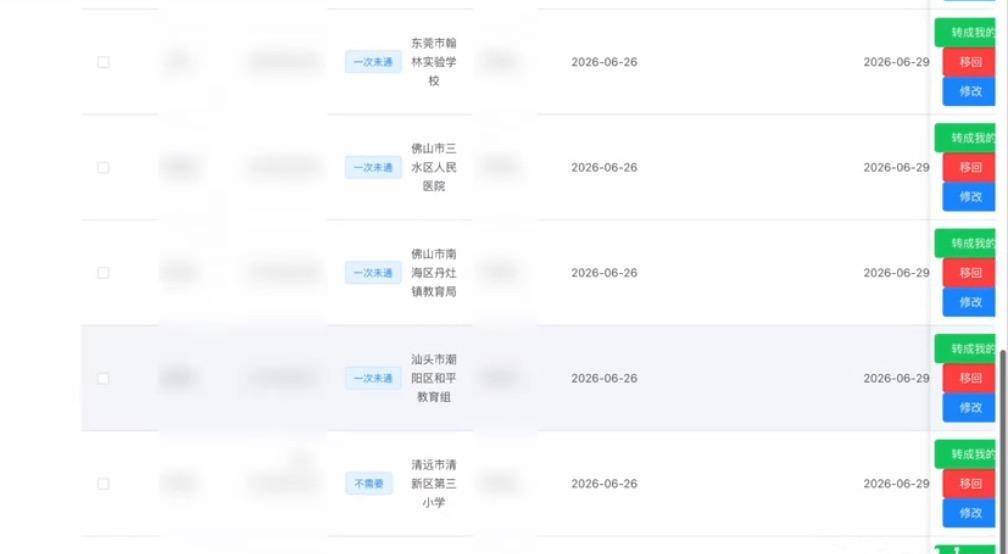
▲The company’s electronic sales system stores more than 100,000 pieces of customer data, covering names, mobile phone numbers, and work units.
Where does this private customer information come from? Internal employees revealed that part of this information comes from information traffickers reselling in bulk through crawlers, and part of it is old information retained by various business teams. Some practitioners of loan assistance companies claimed that some high-quality customer data were suspected to come from within the bank, but reporters could not verify this statement.
After getting the customer’s phone number, the salesperson’s core task is to pretend to be a bank staff member and invite the customer to the company. This set of words is printed on the company’s paper training materials:
For example, they made up the excuse that “the company has entered the bank’s whitelist and pre-approved the credit limit”; they never mentioned “service fees” on the phone, but said that interest would be calculated according to the bank’s normal interest rate, insisting that “the loan will definitely be granted”; if customers want to verify their job numbers, they can just report a string of six-digit numbers, “they won’t check anyway”; use limited-time interest discounts to create tension. Feeling of pressure, “If you apply in July, you can get interest-free for 3 months, but the policy will be canceled in September. If you are late, the quota will be gone.” If the customer wants to go to the bank counter on his own, he will claim that the counter does not accept this type of exclusive products and can only connect with the company, cutting off the verification channel… Once the trick is revealed and suspicion is raised, the customer will change the salesperson and change the identity to continue the communication.
What should I do if a high-frequency outbound call is marked as a harassing call? The salesperson said that the company has “channels”, and it only costs 20 yuan to remove the mark if it is blacklisted for high-frequency calls or harassment, and it can be unblocked if it is blacklisted by the operator and costs 100 yuan.
▲The phone number of the loan assistant is marked after high-frequency outbound calls, and you can spend money to unblock it.
In short, making appointments with people to the company is the first goal of the telemarketing team. It doesn’t matter whether the customer’s qualifications meet the standards or whether the loan can be finally granted. As long as the customer can come to the company, there will be a dedicated “order negotiation” supervisor to follow up and convert.
“The thinking of a liar is not to teach you to deceive people, but to learn to dig hooks. Do you want to know whether the liar is thinking of ways to deceive people?” Telemarketers receive a commission of nearly 50% for successful conversions, and those with the highest number of door-to-door records each month will receive cash rewards. While the reporter was undercover, one employee earned as much as 50,000 yuan a month.
(三)
Real or fake “bank channel”?
The loan assistance company claims to have “internal staff cooperation”
Why do borrowers like Mr. Wu ignore formal banking channels and would rather travel thousands of miles to find loan assistance?
During the undercover period, Red Star Deep Dive reporters found that visiting customers can be roughly divided into two categories: one type has poor credit, and after encountering a wall in the bank, they rely on what they call “internal bank channels”; the other type has good credit qualifications and can apply directly to the bank, but they believe the so-called “exclusive credit” and “limited time discounts” of the loan institution.
What really makes it difficult for borrowers to bypass loan facilitators is what they call “internal channels of the bank.” Is the core link of this gray chain true or false? Red Star Deep Dive reporter’s undercover investigation found that this set of “channels” packaged as powerful is a key means for them to take advantage of the opportunity to charge fees and lock in customers.
Many customers came to the door and discovered that the so-called “Bank Credit Department” was hidden in an ordinary office building. There was neither a bank sign nor a business counter. The reporter undercover reported that the company’s signboard was “Guangzhou”·Ninth Business Acceptance Center”.
▲廣州·Ninth Business Acceptance Center
During the interview, the supervisor will claim that this is a credit acceptance center outsourced by the bank, and its performance is evaluated based on the bank’s loan volume, which is different from ordinary intermediaries that charge handling fees. Mr. Wu, who is in charge of banking channels, is packaged as a “bank-based risk control specialist”. With this official profile, he gradually allows customers to put down their guard and smoothly obtain ID cards, provident fund authorization and other materials to match loan products. He even privately submits materials to go through the online loan approval process without the customer’s knowledge.
The charging link is even more mysterious. Since the service fee was claimed to be zero in the early stage, the service fee had to be packaged into the risk control cost of “clearing bank relationships and managing internal channels” after customers had developed expectations for the loan plan. The customer was informed that after the loan was completed, settlement would be settled with the bank channel. Ordinary credit charges 3 to 5 points, and customers with poor qualifications and urgent need for money can receive up to 20 points.
Mr. Chen, a customer from Heyuan, originally wanted to borrow a new loan to replace multiple online loans. The supervisor did not mention the fee during the initial negotiation. After the pre-assessment, he threw out a “bank channel cost” of 4.5 points, claiming that it was to open up the provincial bank quota and to avoid the risk of capital backflow, and to pay for the invoice for the decoration loan. However, according to the Red Star Deep Dive reporter, the so-called “bank channel cost” is essentially the loan assistance service fee.
According to the company’s loan assistance staff, a customer once submitted loan applications seven times but was not approved, and the loan interest rate finally quoted was higher than the actual approved interest rate by the bank. As for the interest rate difference, they explained to customers that there were too many applications and frequent credit inquiries in the early stage. Banks need to strengthen risk control and require customers to return part of the interest in advance. The reporter asked whether the bank really had such regulations, and the loan facilitator replied “no”. The interest rate difference was actually charged by the loan facilitation company as a handling fee.
▲Reporters undercover the office environment of a loan assistance company
The loan assistance company also claims to have some kind of connection with bank insiders and can artificially control the lending time in order to obtain high handling fees.
Subsequently, the reporter followed the supervisor’s instructions and directed Mr. Chen online to a local bank in Heyuan for an interview. It was clearly requested that words such as loan assistance and handling fees should not be mentioned, so as to avoid being discovered by the bank that “internal employees colluded with intermediaries”, and he was designated to connect with a “bank account manager surnamed Huang”.
▲The supervisor instructed the reporter to take the client Mr. Chen to meet with a bank account manager surnamed Huang.
A person from the loan assistance company told reporters that cooperative banks have corresponding “handlers”, that is, “bank internal personnel” who need to manage relationships on a daily basis. The point of cooperation between the two parties lies in the control process. After the loan is approved, the “handler” will temporarily withhold the loan and instead ask the customer to return to the loan assistance company and pay the service fee before disbursing the loan. The loan facilitator said this was to prevent the customer from “jumping the order” after receiving the full payment: “If we didn’t do a good job, the bank would directly lend the money and let the customer go, and we would have done nothing.”
Because Mr. Chen’s loan application was not approved in the end, the Red Star Deep Dive reporter has not been able to find out whether the loan assistance company’s claim that “the ‘bank handler’ can temporarily withhold the loan but not disburse the loan” is true.
According to the “Notice on Carrying out Special Censorship Actions for Illegal Loan Intermediaries” issued by the former China Banking and Insurance Regulatory Commission in March 2023, a six-month governance action was deployed. All financial institutions must effectively strengthen employee behavior management and investigate whether grassroots staff of banking financial institutions have privately colluded with loan intermediaries, recommended loan intermediaries to customers, and relaxed loan review standards and post-loan management standards for customers recommended by loan intermediaries.
Zhao Liangshan, a lawyer at Shaanxi Hengda Law Firm, believes that in accordance with regulatory regulations, banks’ third-party customer acquisition cooperation must be managed by the head office or first-level branches through a unified admission and list system. If it is true that the grassroots account managers privately receive customers from intermediaries, it is suspected of illegal cooperation without approval.
Intermediaries intervene in advance to screen customers, which can easily negate the bank’s independent risk control and bring about hidden dangers such as false propaganda, hidden charges, information flow, and benefit transfer. This is an abnormal exchange between employees and intermediaries that is a key regulatory focus.
He mentioned that when intermediaries fabricate internal channels and charge high service fees, account managers are not absolutely immune. If you know or should know that an intermediary is misleading customers, but continue to accept customers and allow problems to occur, the account manager may face internal sanctions and regulatory accountability; once there is any behavior such as cooperating with publicity and profiting from it, the accountability will be further aggravated.
(四)
Conduct illegal operations such as “house financing” to obtain huge profits
Participants suspected of fraudulently obtaining loans
▲The reporter participated in speaking skills training while working undercover at a loan company
Even if the bank loan approval fails, the loan facilitator will not end the business, but will further recommend alternatives, or induce the customer to find relatives and friends with good credit scores to come forward for loans, which is the “AB loan” encountered by Mr. Wu;
Red Star Deep Dive reporter saw in the company’s all-customer registration form that there were many customers whose qualifications were marked as “husband’s credit score is not good, wife will be the principal borrower”, and some customers were noted as “not qualified, follow up to see if someone around them can do it”; in the door-to-door registration form, you can also see “let her son be the principal borrower” and “spouse’s credit score is clean” and other markings. Customers whose credit score or qualifications are not up to standard are eventually matched with high-cost plans such as “house financing”, “car financing”, “capital allocation” and “debt restructuring”.
The “housing financing” business is to help customers without loan qualifications obtain bank credit funds through an operation chain of advancing funds to purchase houses and providing high-quality loans. The single service rate can be as high as 20%.
▲After the customer comes to the door, he will hand it over to the senior supervisor to discuss the order.
Insiders of the loan assistance company told reporters that they will first advance money to help customers buy a second-hand house, then use the appraisal agency they cooperate with to estimate the house price at an inflated price, and then use the customer’s name to go to the bank to apply for a real estate mortgage loan. When the bank loan arrives, the principal advanced by the company to buy the house will be deducted first, and the remaining money will be given to the customer for free use. For those who originally could not meet the bank loan requirements, this is equivalent to having an extra house in their name out of thin air, and they can get a large loan from the bank at once.
This business is mainly aimed at customer groups with urgent financial needs and no requirements for the real estate itself. While the reporter was undercover, a young man who urgently needed to raise funds for his sister to go to school was matched with this plan. He has already been loaned more than 800,000 yuan. Although he has a temporary amount of funds, the service fees, interest on advance funds, and handling fees may be as high as 160,000 yuan. He also has to repay a loan of tens of thousands of yuan every month, which is extremely risky.
This type of high-risk business is the company’s real “source of huge profits.” A manager of the company admitted to reporters that from just one housing financing and debt restructuring business, the relevant salesperson’s income can reach 100,000 yuan. During a training session, the supervisor would also individually screen out customers who were suitable for car financing: “There are some customers with three no qualifications who can finance cars because they accept high fees.”
The lawyer made it clear that these behaviors were essentially illegal operations to deceive banks, and both loan customers and business personnel were suspected of defrauding loans. Many loan assistance personnel are also aware of the compliance risks of this business. They bluntly stated that “housing financing is illegal” and is essentially a fraudulent loan. However, they claimed that “if the operation is in place, the loan assistance (company) will not be implicated.”
(五)
Loan assistance company’s low cost is illegal
Victims find it difficult to defend their rights
Mr. Wu initially only had a housing loan of 700,000 yuan. After many rounds of advances, transfers, and real estate transfers, the loan amounted to 1.05 million yuan in his sister’s name alone. After excluding about 80,000 yuan in cash on hand, the new debt amounted to more than 200,000 yuan. My sister has no stable income, and her mortgage is currently overdue by about 100,000 yuan. Debt always worried him.
On September 16, 2025, the police filed a case against Mr. Wu for being defrauded. Mr. Wu is worried that the existing materials may not meet the standard for routine loan identification, or it may be a civil dispute, and the only option is civil litigation. However, Mr. Wu, who was already in debt, was unable to afford the cost of litigation, and the path to safeguarding his rights was difficult.
Regarding Mr. Wu’s case, the reporter called the Pujun Police Station of Chancheng Branch of Foshan Public Security Bureau, and the operator suggested contacting the police handling the case. The reporter called the police station handling the case, but the call was not answered yet. The phone number of the Chancheng Branch of the Foshan Public Security Bureau was also not connected, and a person who had participated in the case said it was inconvenient to be interviewed.
▲After newcomers join the company, the loan assistance company issues deceptive tactics for telemarketing
Regarding the core difficulty of distinguishing between routine loans and ordinary loan-assisted civil fraud, Zhao Liangshan, a lawyer at Shaanxi Hengda Law Firm, explained that it lies in the proof of subjective illegal possession. Civil fraud is generally exaggerated publicity and concealment of information for the purpose of earning intermediary fees; routine loans are designed to be a closed-loop trap, with the intention from the beginning to increase debts, inflate claims, and ultimately occupy the victim’s property. It cannot be directly presumed that the crime of routine loans is just because the debt is growing.
However, if you know beforehand or during the event that an upstream loan-assisting institution is implementing a routine loan scam, and still cooperate in lending, withdrawing funds, and deducting principal and interest, to jointly achieve the purpose of inflating debt and possessing the victim’s property, the advance and pawn institution may constitute an accomplice in routine loan or related fraud.
Zhao Liangshan pointed out that the behavior of loan salesmen posing as bank personnel, fabricating whitelists and exclusive credit extensions has the dividing line between civil fraud and criminal fraud: whether the identity is fabricated for the purpose of illegally possessing property, and whether the victim disposes of money based on this false identity.
If it is just to attract traffic, then truthfully disclose the identity and fees of the intermediary, and only exaggerate the channel capabilities, it is civil fraud and false propaganda; if the identity of the bank’s risk control personnel is fabricated, high service fees and AB loan risks are concealed, and the customer is tricked into paying directly and inflated debts, with the subjective purpose of illegal possession, it can be included in the criminal fraud evaluation.
If it can be verified that there are indeed collusions between bank insiders and loan-assisting institutions, and by temporarily withholding loans and controlling approvals to force customers to pay service fees, the bank staff will be guilty of bribery or non-state staff bribery, depending on their status, and the loan-assisting agency personnel will become an accomplice; if there is also the act of defrauding loans with fictitious materials, they may also constitute an accomplice in the crime of fraudulently obtaining loans. The essence of this type of behavior is to use the convenience of one’s position to make profits with lending authority, which is a typical internal and external collusion crime in the financial field.
Zhao Liangshan explained that at present, administrative penalties for loan assistance institutions that pretend to be banks to solicit customers are relatively weak, with warnings and small fines being the main ones, which cannot serve as a sufficient deterrent. He suggested that the general public should strengthen the distinction between such gray routines in loan assistance. Regular institutions will not pretend to be bank staff, will not promise “internal channels, credit repair, and guaranteed loans,” will not induce relatives and friends to “transfer accounts, name loans,” and will not require cash, private account transfers, or pay money first before lending; they will not recommend false transaction arbitrage schemes such as advance capital transfers and high-rating and high-loan housing financing.
As a borrower, the reporter called the customer service of a large bank that was introduced to the customer by a loan assistance company. The customer service hotline informed that the bank would not use private mobile phone numbers to call customers to promote loan business. Official contact customers generally use a five-digit official number or a fixed telephone number registered at the branch.
It stated that the bank does not have any such institution as the so-called “Ninth Acceptance Center”, nor has it authorized or entrusted any external company or platform to carry out lending business on its behalf. The bank keeps customers’ personal information strictly confidential and will never disclose customer names, contact information, workplace and other private data to the outside world.
In response to the so-called “laundering of funds through renovation loans” operation by loan assistance institutions, customer service made it clear that this behavior was illegal. The bank will verify the actual use of the loan funds, and the loan funds are strictly prohibited from being used to repay other debts. Once it is verified that the actual use is inconsistent with the contract, the bank has the right to terminate the loan and require the borrower to settle all the arrears at once. The so-called third-party turnover to avoid flow verification is simply not feasible and will still be identified by the bank.
At the same time, borrowing the credit of relatives and friends to apply for loans is not a compliance business recognized by banks. Regular banks will not guide customers to carry out such high-risk operations.
As of press time, the reporter tried to contact the loan assistance company and relevant banks involved in the above investigation, but no effective response was obtained. The reporter has handed over the relevant clues collected during the investigation to the relevant law enforcement departments of Guangzhou City. Red Star Deep Dive reporters will continue to track the follow-up progress.
Related Reading
- In chaotic L.A. skies, news helicopter pilots juggle competition, camaraderie, risk2026-09-20
- Trump says he will form an “artificial intelligence army”2026-09-20
- 13-year-old Yu Zidi broke the Asian Games record and won the gold medal!2026-09-20
- The State Administration for Market Regulation is clear! This type of infant formula food must not continue to be sold2026-09-20