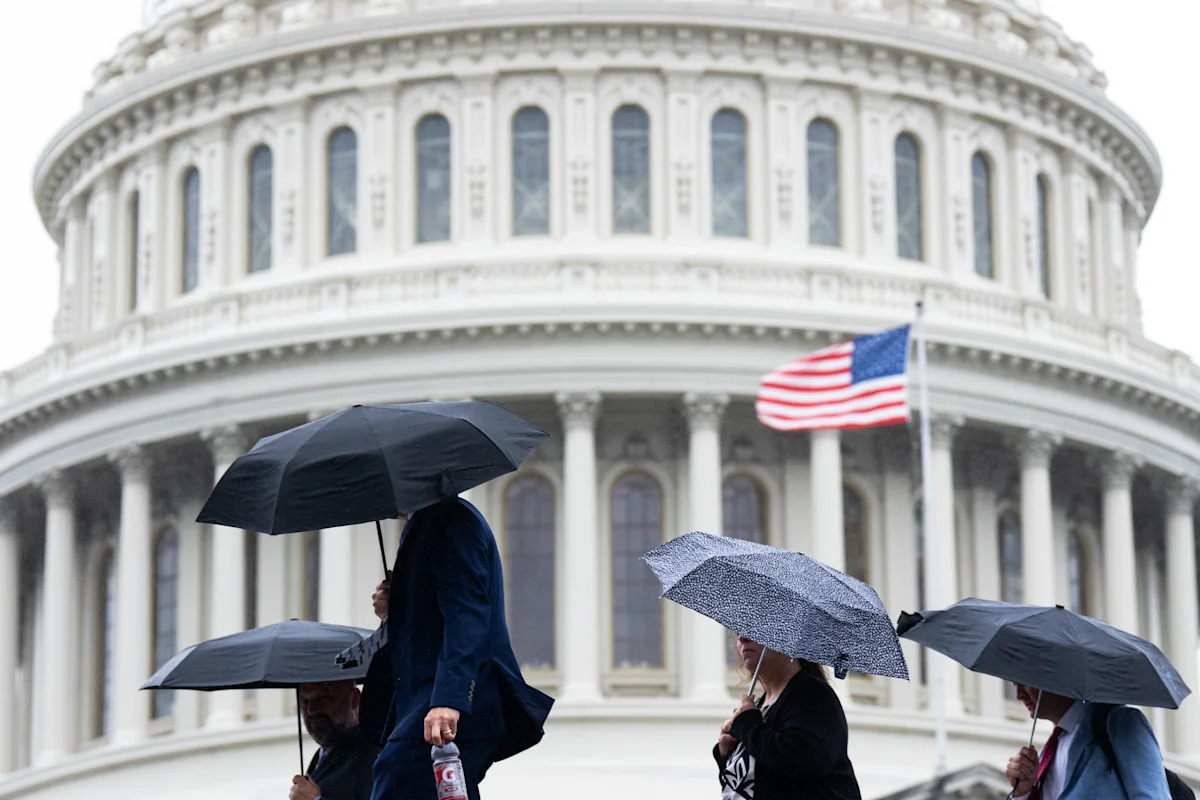
The US Senate is set to leave Washington soon for election-season campaigning after two failed votes Wednesday on highly charged issues: AI data center costs and lawmakers’ stock trading.
The Ratepayer Protection Act and the Stop Insider Trading Act were blocked by Democrats and fell short of the required 60 votes to advance in tallies of 57-43 and 53-47, respectively.
The data center bill garnered a handful of Democratic votes — but not enough to advance the legislation — while the stock trading bill failed on a party-line vote.
The political pattern around both bills was similar: Republicans charged Democrats with obstruction, while Democrats countered that both GOP-sponsored measures were bad-faith attempts to address serious issues.
Voters have strong feelings about the costs associated with data centers and insider trading by members of Congress. To that end, both sides staked out their campaign trail positions. Senate Majority Leader John Thune described the bills as “eminently commonsense pieces of legislation,” while Democratic Leader Chuck Schumer shot back and called the data center bill “a fraud.”
With a little over a month until the midterms, Democrats are bullish on their odds of winning majorities in Congress while Republicans search for ways to avoid a drubbing at the polls.
But on these issues at least, neither side will have results to show beyond the rhetoric.
On the Ratepayer Protection Act, Democrats aim to “prevent Republicans from gaining a political victory ahead of the midterms and hope that obstructionism does not resonate with voters,” Stifel chief Washington policy strategist Brian Gardner wrote in a client note.
The votes on Wednesday afternoon are widely expected to be among the last before Senators go home to campaign. The House adjourned two weeks ago and is not scheduled to return to Washington until Nov. 9.
No agreement on lawmaker stock trading ban
Republicans have been pushing a measure in recent months to limit, but not fully ban, lawmaker stock trading. President Trump even called for the measure’s passage in his State of the Union address.
But the measure was dead on arrival among Democrats, as the bill was amended to include controversial election-related provisions that Trump has also called for.
The Stop Insider Trading Act would prohibit lawmakers and their families from purchasing new stocks, but it would allow lawmakers to continue owning individual stocks. It would also require a public notice at least seven days before any sale.
Related Reading
- Depth丨The outcast Huang Renxun, and the trillion-dollar Nvidia that has lost its helmsman2026-11-15
- Original: Wang Jianlin, 72, re-appointed as chairman of Wanda2026-11-15
- The former chairman voluntarily surrendered! With three changes of leadership in four years, how many question marks does Xiamen Bank hide?2026-11-15
- Behind the U.S. grounding: the air traffic control system has been in service for 50 years, and spare parts rely on overseas purchases2026-11-15
- Hesai, Shenghong, and Nvidia reveal the “pricing system” of technology tycoons’ extramarital affairs2026-11-14