The USMNT’s 24-year knockout win drought: Why World Cup knockout games are harder than group matches
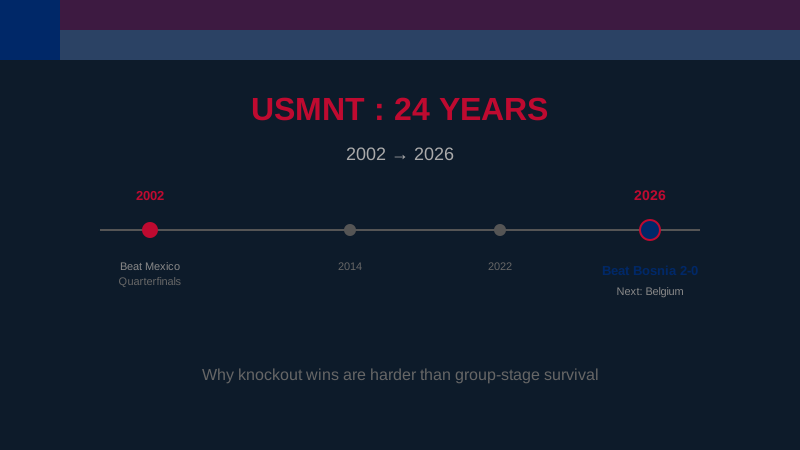
On July 1, 2026, the United States men's national team defeated Bosnia and Herzegovina 2-0 in the Round of 32 at Levi's Stadium in Santa Clara, California. It was the USMNT's first knockout-stage victory at a World Cup in 24 years — since the 2002 tournament, when the U.S. beat Mexico 2-0 in the Round of 16. The long gap is often framed as a failure of American soccer development, but the reality is more structural.
Knowledge point: why knockout games are different
Knockout tournament football operates under different statistical and psychological rules than group-stage play. Five key factors explain why a team that survives the group stage can still struggle in the knockout phase for decades:
1. Sample size and variance. A World Cup group stage is 3 matches. A knockout run requires 4–7 additional wins. With small sample sizes, variance is high — even good teams can lose a single knockout match to a weaker opponent on an off night. The USMNT qualified for knockout rounds in 1930 (semifinals), 1994 (Round of 16), 2002 (quarterfinals), 2014 (Round of 16), and 2022 (Round of 16), but only won in 1930, 1994, and 2002. That suggests the team has been competitive enough to advance from groups at a reasonable rate — approximately once every 3.5 World Cups — but not consistently strong enough to survive the higher-pressure knockout environment.
2. Squad depth. Group-stage matches allow rotation. Knockout matches demand the best XI, with limited substitutions (five in 2026) and extended minutes. A thin squad is exposed when starters tire, get injured, or face red cards — as the USMNT experienced when Folarin Balogun received a controversial red card in the 64th minute of the Bosnia match. The team defended for 30 minutes with ten men and still won, but depth remains a concern heading into the Round of 16 against Belgium.
3. Tournament experience. Research published in the Journal of Sports Sciences shows that national teams with higher average caps per player tend to overperform in knockout stages relative to their FIFA ranking. The USMNT's squad in 2026 had an average of 28 international caps — significantly lower than traditional powers like France (52), Spain (48), or Brazil (45). Experience matters most in high-pressure moments: set-piece defending, penalty management, and tactical adjustments mid-match.
4. The Balogun factor. The red card shown to Balogun in the 64th minute — FIFA later confirmed a one-match suspension — illustrates how knockout football amplifies the impact of individual decisions. In a group match, a red card might mean dropping points but still advancing. In a knockout match, one suspension can derail the entire campaign. The USMNT now faces Belgium without its most prolific striker, forcing manager Mauricio Pochettino to adjust his entire attacking structure.
5. Opponent quality gradient. Group-stage opponents vary widely. In 2026, the USMNT's group included teams of different strengths — allowing the team to accumulate points even if one match went poorly. In the knockout stage, every opponent has already proven they can win elimination matches. Belgium, the USMNT's Round of 16 opponent, came back from 2-0 down to beat Senegal 3-2 in extra time — a comeback that required both technical quality and mental resilience.
What it means for American soccer
The 24-year drought is not a measure of failure so much as a reminder of how hard it is for any national team outside the traditional elite to win knockout matches consistently. Even Germany — a four-time World Cup winner — exited in the Round of 32 in 2026, losing to Paraguay. The gap between "good enough for the group stage" and "good enough to go deep" is wider than casual fans often assume. The USMNT's win against Bosnia is an important step, but the structural factors that kept them from winning knockout games for 24 years will not disappear overnight.