Space & Astronomy
NASA awards $600M for Moon base cargo missions to three companies
In late June, NASA committed nearly $600 million across Astrobotic, Firefly Aerospace, and Intuitive Machines for four commercial lunar lander missions. The payloads will test life support, power systems, and resource extraction technologies needed for a permanent human outpost.
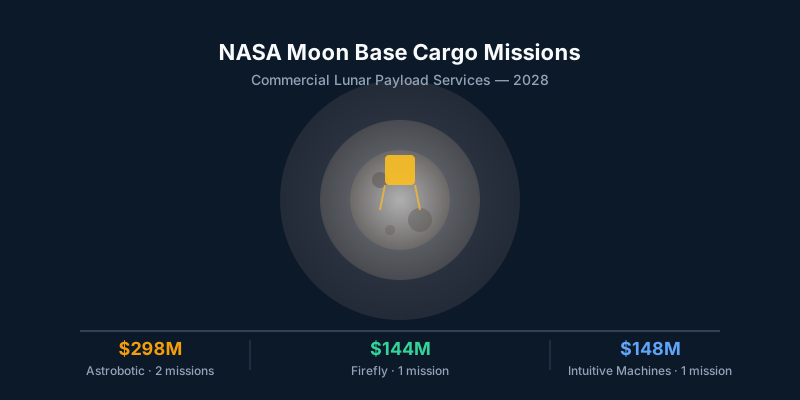
- Astrobotic received $297.9 million for two missions, Firefly Aerospace $144.2 million for one, and Intuitive Machines $148.3 million for one — all targeting late 2028.
- Each lander will carry a standardized set of NASA science instruments focused on in-situ resource utilization (ISRU), radiation monitoring, and precision landing technology.
- The missions are part of the Moon Base Program, which aims to establish a permanent human-occupied outpost near the lunar South Pole by the early 2030s.
On June 30, NASA announced the latest round of Commercial Lunar Payload Services (CLPS) awards, selecting three companies to deliver a total of four missions to the Moon. The $590 million in contracts represents a significant acceleration of the agency's Moon Base Program, which envisions a continuously crewed outpost near the lunar south pole within this decade.
Astrobotic, the largest awardee, will fly two missions totaling approximately $298 million. The Pittsburgh-based company will carry a suite of instruments designed to extract water from lunar regolith and test oxygen production — both critical capabilities if astronauts are to live off the land rather than haul supplies from Earth. Firefly Aerospace's $144 million mission and Intuitive Machines' $148 million mission will add radiation shielding experiments and precision-landing sensor arrays.
The landings are scheduled for late 2028, a timeline that aligns with NASA's broader Artemis campaign milestones. The science returned from these cargo missions will directly inform the design of habitat modules, power grids, and life-support systems for the base itself. Unlike Apollo-era sorties, the Moon Base Program treats the lunar surface as a permanent destination, not a visit.
For observers, the size and speed of these awards signal that NASA is transitioning from planning to procurement on the Moon Base. Three companies with proven lander designs — each having already flown CLPS missions — means the risk profile is lower and the timeline more credible than earlier lunar program phases.