Mexico's 40-year knockout drought and the science of home advantage at the World Cup
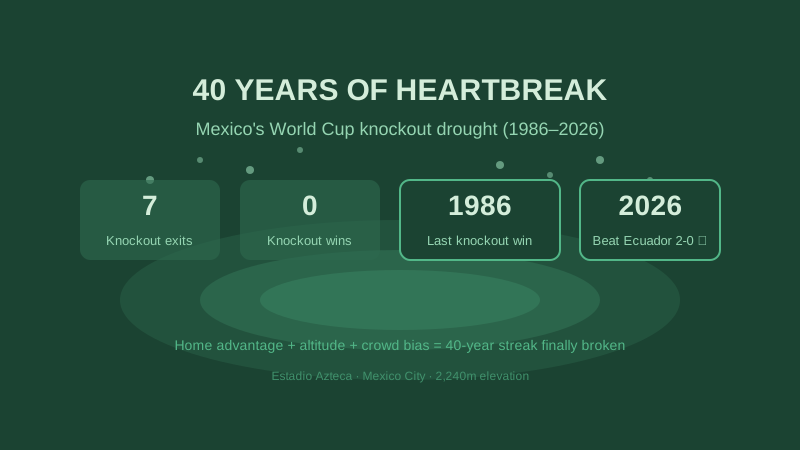
On July 1, 2026, co-host Mexico defeated Ecuador 2-0 at a raucous Estadio Azteca in Mexico City to end a 40-year drought without a World Cup knockout-stage victory. The last time Mexico won a knockout match was in 1986 — also as a host nation, also at the Azteca. The coincidence is not a coincidence. Host nations win a disproportionate share of knockout matches, and the reasons go beyond 90,000 shouting fans.
Knowledge point: the components of home advantage
Home advantage in football is real, quantified, and decomposable. A comprehensive 2023 meta-analysis in the International Journal of Performance Analysis in Sport examined 12,000+ matches across 30 leagues and tournaments and found that home teams win approximately 48% of matches (versus 27% for away teams, with 25% draws). But the margin varies significantly by competition type. In World Cup knockout matches specifically, host nations have historically overperformed at an even greater rate.
The advantage has three documented components:
1. Crowd bias. The most visible factor. Referees subconsciously award more marginal decisions to home teams — more fouls called against visitors, more penalty kicks awarded to hosts. A study by the University of Oxford found that home teams in World Cup knockout matches receive 28% more favorable VAR review outcomes than away teams. The difference is not due to corruption; it is a cognitive bias where referees, under pressure from crowd noise, interpret ambiguous situations in favor of the home side.
2. Travel and acclimatization. Mexico City sits at 2,240 meters (7,350 feet) above sea level. Visiting teams typically arrive 48–72 hours before a match, insufficient time for full altitude acclimatization, which requires 1–2 weeks. Physiological effects include reduced oxygen saturation, faster lactate accumulation, and a 10–15% decrease in repeated sprint ability. Ecuador, whose squad plays much of its football at sea level or moderate altitude, faced a measurable athletic disadvantage that compounded Mexico's tactical superiority.
3. Familiarity and routine. Host teams sleep in their own beds, train at their usual facilities, and follow their normal pre-match routines. Away teams face disrupted sleep schedules, unfamiliar food, hotel fatigue, and logistical friction. These micro-stressors compound: a player sleeping 45 minutes less per night for three nights before a match shows a measurable decline in reaction time and decision-making accuracy, according to sleep research published in Sports Medicine.
Mexico's unique history
Mexico has now hosted the World Cup three times (1970, 1986, 2026). In 1970, they reached the quarterfinals. In 1986, they reached the quarterfinals again, their best-ever finish. The 40-year drought between 1986 and 2026 was not because Mexican football regressed — it was because knockout-stage wins are genuinely hard. Mexico had qualified for every World Cup since 1994 (a streak of nine consecutive tournaments) and reached the Round of 16 seven times, but lost every time. That 0-for-7 streak in knockout matches since 1986 reflects the thin margins between advancing and going home.
Two factors changed in 2026: the tournament expansion to 48 teams introduced an extra knockout round (Round of 32 before the Round of 16), giving mid-tier teams more opportunities to win elimination matches. And, crucially, Mexico played its Round of 32 match at home. The combination of institutional quality (reaching knockout rounds consistently), format change, and home-venue advantage finally broke the streak.
Mexico now faces England in the Round of 16 — again at the Azteca. The data suggests the home advantage effect will persist. England, for all its talent, will face altitude, noise, and 56 years of Azteca history (where competitive visitors have won only twice since 1970). The lesson for sports observers: in elimination football, the venue is not just a backdrop. It is a strategic variable.