Technology
Anthropic's Honeycomb leak signals Opus 5 is close
An unreleased model called Claude Honeycomb briefly appeared in the Cursor editor on July 8, sporting a 1-million-token context window and extra-high effort settings. Its disappearance and a third free-access extension for Fable 5 suggest the next flagship Opus model may arrive within weeks.
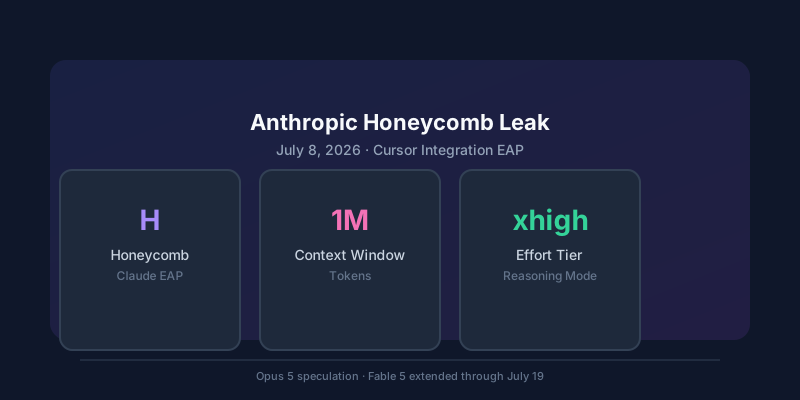
- A model named Claude Honeycomb EAP surfaced in Cursor on July 8 with a 1,000,000-token context window and safety fallback to Opus 4.8, then vanished within hours.
- Anthropic has now extended free access to Claude Fable 5 through July 19 — the third such extension in five weeks — while declining to comment on Opus 5 timing.
- Prediction markets price a 2026 Opus 5 release above 90 percent probability, with the Honeycomb leak interpreted as a late-stage integration test.
On July 8, developers using the AI-powered code editor Cursor spotted an unfamiliar model option: Claude Honeycomb EAP. Its specification sheet listed a one-million-token context window, an xhigh effort tier for complex reasoning, and a safety fallback that routed certain requests to Opus 4.8. Within hours the option disappeared, but screenshots circulated widely.
The Honeycomb name follows Anthropic's internal convention of using thematic codenames — Sonnet, Opus, Haiku, Fable — before public branding. A model with a million-token context and an Opus-class safety fallback is almost certainly a pre-release variant of the next flagship, widely expected to be called Opus 5.
Two days later, on July 10, Anthropic announced a third extension of free Fable 5 access for paid subscribers, pushing the usage-based pricing transition to July 19. The company has not commented on Opus 5 directly, but the pattern — free-tier extensions coinciding with internal model leaks — mirrors the weeks before Sonnet 4 and Opus 4 launched in 2025.
For developers and organizations budgeting AI spend, the signal is practical: if you are committing to annual credits or platform contracts, the next four weeks may bring a model that significantly raises the capability ceiling for coding, long-context analysis, and agentic workflows. Watch for an official announcement before the July 19 pricing deadline.